Sold out,
then closed.
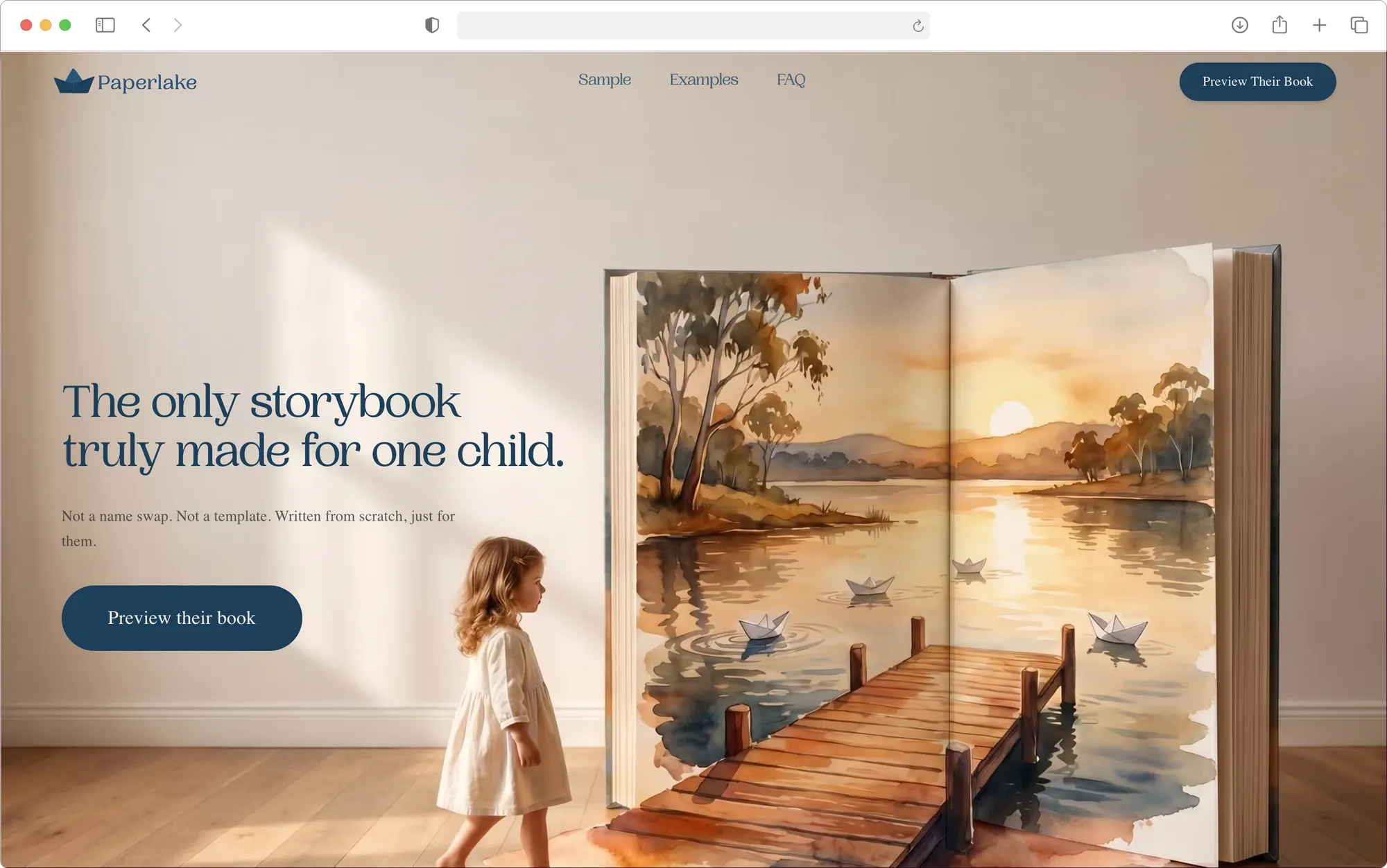
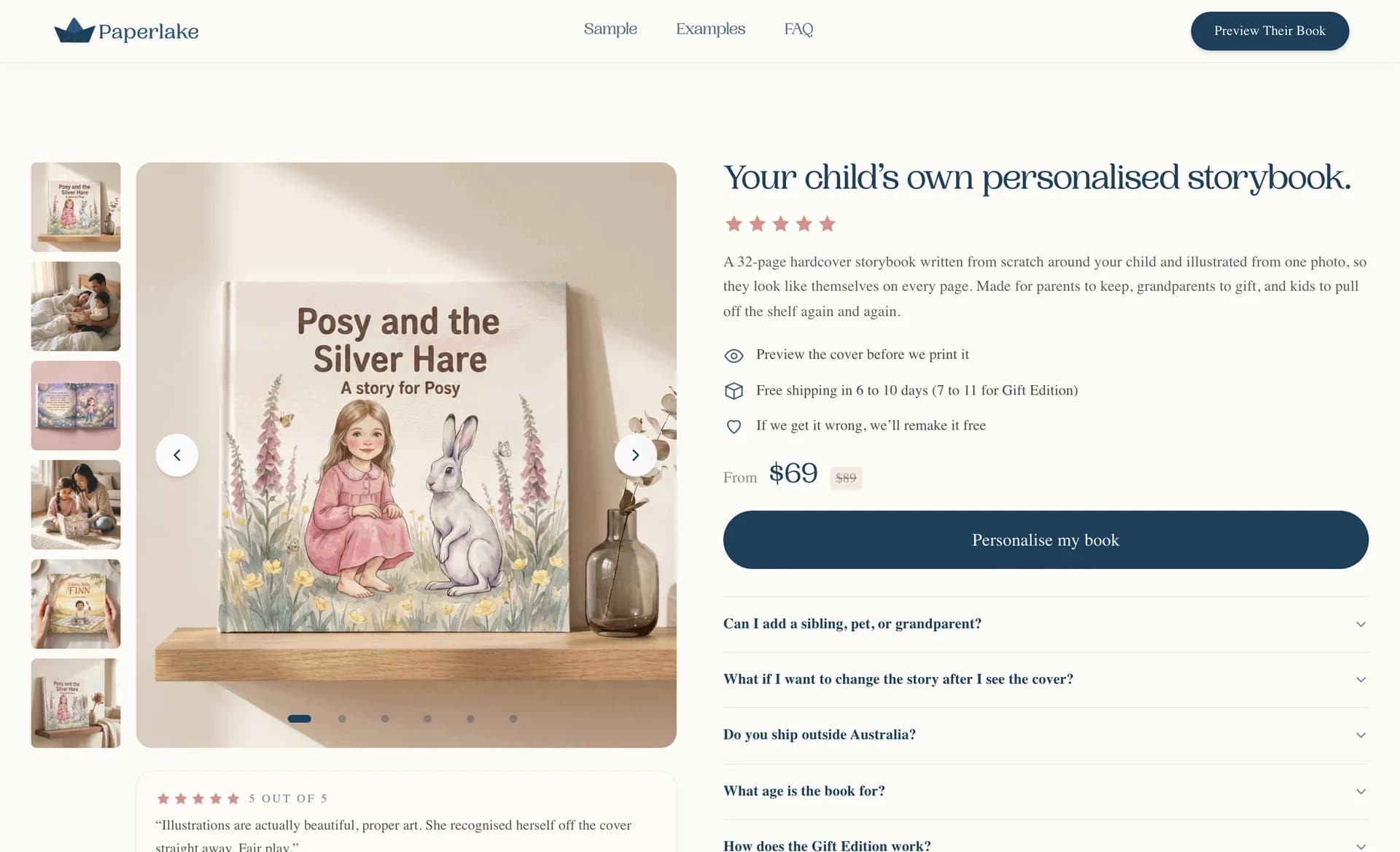
Paperlake writes and illustrates a 32-page hardcover around one child, from one photo, and prints it in Sydney. It filled every spot in its production run, so we replaced the order form with a waitlist rather than ship books we had not checked.


Every other personalised book is a name sticker.
The personalised children's book market runs on pre-drawn art. You type a name, pick a skin tone from six swatches and a hair colour from eight, and the same illustration ships to every family who chose that combination. The child never sees themselves.
The reason nobody did it properly is that character consistency is genuinely difficult. A book is worthless if the child is recognisable on page four and a stranger on page twenty. Every spread has to hold the same face across different scenes, angles, lighting, and distances.
The second reason is print. An illustration that looks good on a phone can be unprintable: text too small at trim, a limb sliced by the fold, a cover that wraps wrong on board. A parent who paid for a keepsake does not forgive that.
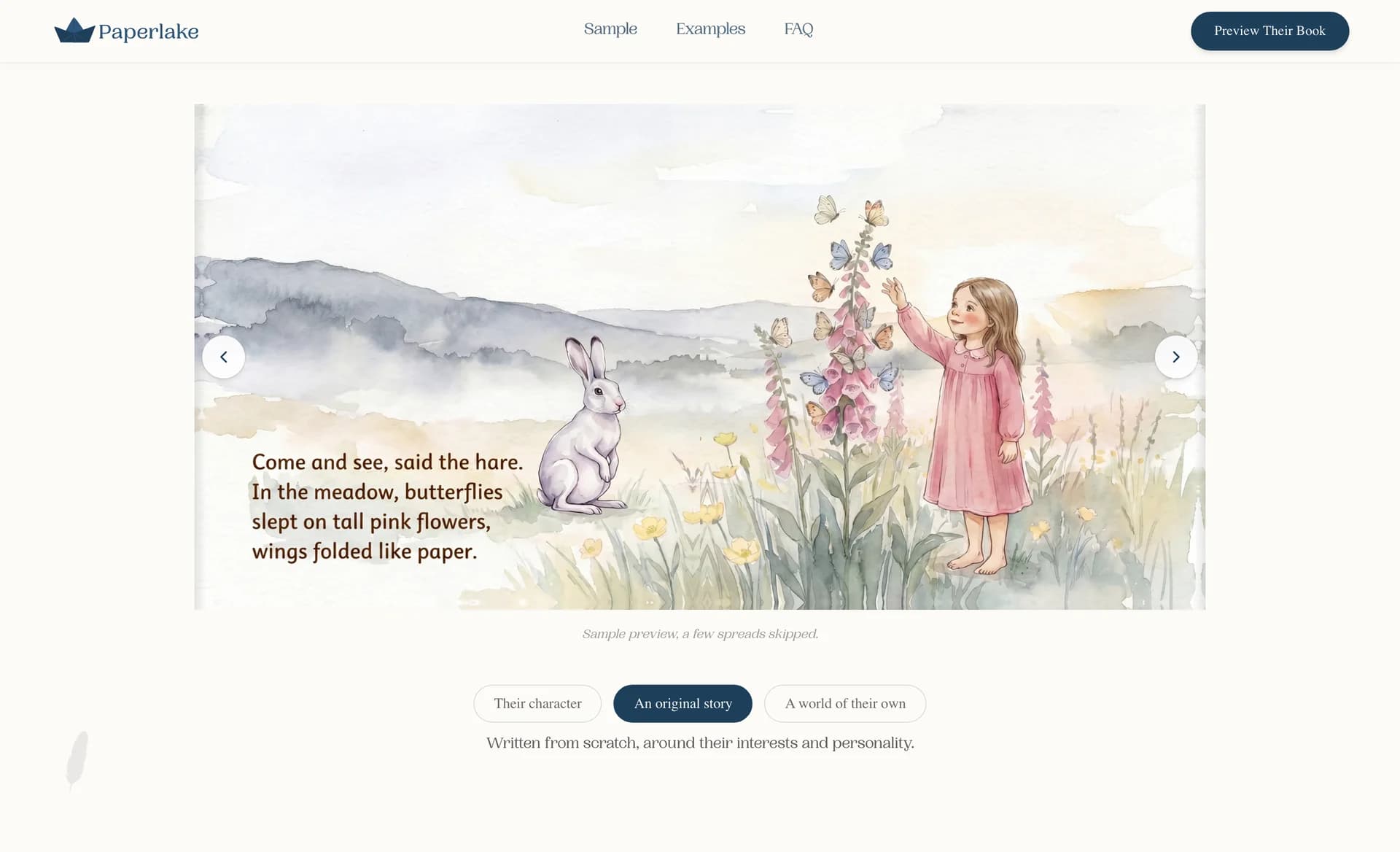
A real hardcover, written from scratch, around one child.
You see the cover before anyone prints anything
The buyer uploads one photo, picks an art style and a story theme, and gets a generated cover with their child on it before they are asked for money. It is the whole pitch in one screen: this is not a template with your name dropped in.
Three tiers, from a $69 paperback to a $119 Gift Edition. Siblings, grandparents, and pets can join the story as extra characters. Two or more books in one cart take 10% off, and the sibling flow carries the art style across so the shelf matches.

Pixar, Watercolour, Disney, Ghibli, or describe your own
Ghibli and Watercolour are the two buyers reach for most. The fifth option is a free-text brief, which is how we learned what to build next without running a survey.
Built around the moment, not the character
A first birthday, a new sibling, the first day of school, finding their courage. Or write your own brief and the story engine builds from that instead.
Printed in Sydney, free shipping in 6 to 10 days
Print and fulfilment run through Gelato's Sydney facility, with status pushed back by webhook. If a book arrives wrong, it gets remade free.
Generated by machine. Printed only on a human yes.
Every book runs the same route from photo to printer. The automation does the work and the checking; a person makes the call. The gate exists because the failure mode here is not a bad web page, it is a hardcover in a five-year-old's hands with their face wrong on page nine.
Only one step in that chain is a person, and it is the one that cannot be removed. Everything either side of it exists to make that review fast enough for one person to run production.
One face, thirty-two pages
A reference set is built from the photo, then every spread is chained to the approved one before it. A wrong face gets a targeted correction pass instead of a re-roll, so fixing page nine cannot change page four.
Twenty-six checks before print
Trim, bleed, and cover wrap are measured against the exact dimensions pulled from Gelato's API per tier. Caption legibility has a hard floor. Limbs crossing the fold are flagged. An AI reviewer reads the book against its own story text.
The founder signs off spread by spread
A purpose-built review tool: draw on the art to raise an issue, snapshot and revert any change, and see which spreads moved since the last sign-off. Issues stay open until a person closes them, not until an agent claims a fix.

Every spot in the run went. So we shut the door.
Nearly two in three books were bought as gifts, which is the behaviour you want from a keepsake: grandparents, aunts, and uncles buying for an occasion with a date attached. Buyers came back for the second child, and one family ordered five books.
That demand met a ceiling that is not the software. The pipeline can generate books faster than one person can look at every spread and decide it is good enough to print for someone's child. When the run filled, the honest options were to lower the bar or stop taking orders.
So the builder was replaced with a hard waitlist gate. No dismiss button, no “continue anyway”, one field. Reopening is a single flag in the code, and the list is warm when it flips.
Sixty-seven pages, and nine that name the competition.
Gift buying is a search behaviour with a deadline. The site covers the occasions people actually type, from first birthday and christening to Christmas stocking stuffers, plus nine head-to-head pages against the incumbent personalised-book brands.

Each comparison page argues against itself
Every head-to-head page carries a section headed “where Paper Lake falls short”: the price is higher, the brand is younger, the review count is smaller. It then says plainly who should buy the competitor instead.
A comparison page that only flatters its own product gets read as an ad and converts like one. Naming the real trade-off is what makes the rest of the page believable, and it is the version an AI answer engine will quote.
We build our own products, so we ship yours from experience.
Paperlake is ours. Nobody briefed it, approved it, or paid for the mistakes. Every decision on it was made with our own money on the other side, which is a different kind of pressure from building to a spec.
Most of what it taught us is portable. Character consistency is an anchoring problem, not a prompt problem. A generative pipeline needs a measurable gate or it will confidently ship rubbish. Server-side purchase tracking is the only tracking you can trust once ad blockers and Safari are in the picture, and we learned that by losing a week of conversions to a script-loading change.
The tooling matters more than the model. What made a one-person production line viable was the cockpit, not the generator.

Common questions about building an AI product
Want a product like it? Here is the stack.
Same studio, same engineering, same published pricing. Pick the entry point that matches what you need built.
Got an AI product idea that has to actually ship?
We build our own products and we build them for other people. Generation is the easy part. Tell us what has to be true before yours can go in front of a paying customer.